Sunday, December 1, 2013

Catfish Po Boys with Pomegranate-Wild Grape Hot Sauce


“You know why they call ‘em hush puppies?”- My Dad

“Why”- Me

“At the end of the fish fry, when the dogs are howlin’ and beggin’, the chef rolls a few balls from the remaining batter. He fries ‘em up, throws ‘em to the dogs, and says ‘Hush puppies!’”-My Dad


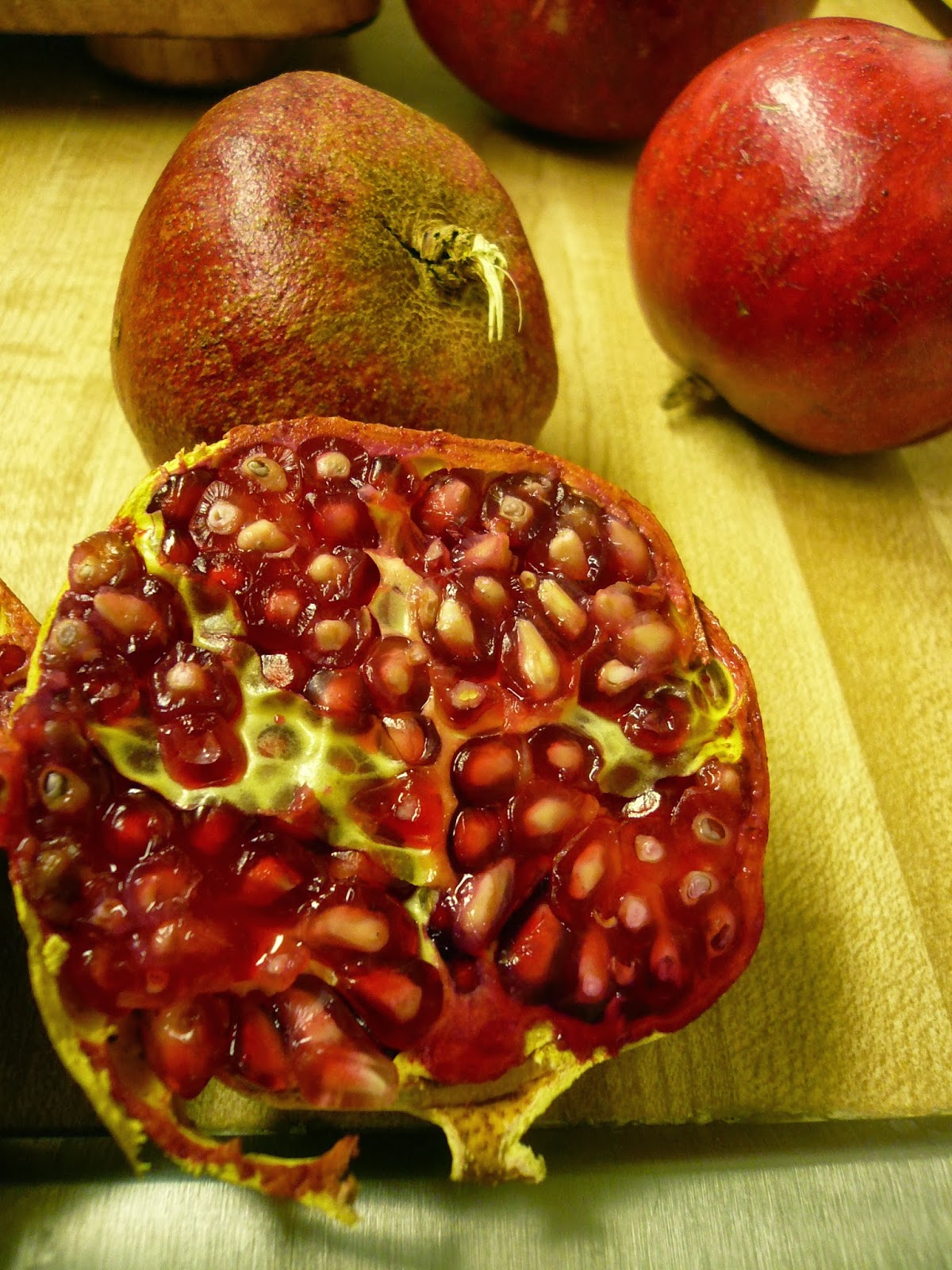
The pomegranates were so ripe they were splitting open on the trees, and after finding a nice patch of wild grape with my buddy Alex, I could resist no more. It was time to get foraging!


The Ph.D. program has been very time consuming, so I have not been posting nearly as much this quarter. That being said, I got to the point last weekend where I just really couldn’t read another page of anthropological theory…so I decided to check out my new foraging zone.

I would far rather support my local COOP grocer than Safeway, but as I was already in their parking lot picking up some hooks and sinkers from the local fishing shop, I stopped into the Safeway for some bait. They looked at me like I was nuts when I requested squid. No luck. But they had prawns. I don’t ever buy prawns because it is one of the least sustainable fisheries in the world (and the farmed varieties pollute the ocean way too much!) But, I needed bait, so I asked the butcher for two. “Two pounds commin up” he said. “No,” I replied with a chuckle, “Two prawns.” He looked at me with the same blank stare…like I was crazy. “What are you doin with two prawns?” he asked perplexed. “Goin fishin!” I replied with a grin.

I found a nice spot on the Sacramento River with a jagged cobble bottom. The opposite river bank was heavily wooded. In the evening sun the calls of nesting red tailed hawks could be heard echoing into the distance. As I cast my bait out to a slack pool behind a riffle, I began to hear splashing up river. I thought it was a fish at first…maybe a fall run salmon…but soon a little furry form climbed out onto the river bank.

As my eyes strained to identify its distant form, another popped its head out of the water and slammed a broad flat tail on the surface of the stream so loud the first animal jumped into the air and then back into the water where they proceeded to play. Beavers! These were the first wild beavers I have ever seen in California. The day was already off to a good start.

After a time I started getting impatient so I wedged the handle of the fishing rod into the rocky bank and swam out looking for crawdads. I found about 10, but the current was so fast I didn’t get a single one. I was even more disheartened when I didn’t come across a single fish! I was starting to think I had picked the wrong spot.

Then, just as I had one foot out of the water while the other was still in my fin’s foot pocket, my fishing rod flew out of its mooring through the air towards the river. Luckily I was in between the pole and the water and it landed straight in my hand! I was momentarily in awe. With a quick look around I thought “Come on! Somebody had to have seen that!” But there was no one without fur or feathers to witness my ninja instincts. My daze was instantly broken when I felt those distinctive tugs! “Fish On!” I hollered aloud to the beavers on the far bank.

The fight was pretty fun (I had admittedly forgotten how pleasurable a little H&L in fresh water could be), and soon I swooped in with my Grandpa’s old net and held up my first ever catfish!


That night I made up a batch of wild grape-pomegranate-habaƱero sauce and got to filleting and frying. We had a batch of hush puppies and golden brown beer-battered fish cutlets in no time flat.


Dinner was a simple southern classic- Catfish Po boy’s. And they were well received. With a little drizzle of freshly foraged spicy reduction sauce and I was in freshwater angler heaven!


Well, I have been praying for rain (this has been the driest January-November in 100 years in California) and today my prayers were answered! Wish us luck, because I smell mushrooms on the horizon!

Keep the old ways alive!

Homemade Samosas and Foraged Persimmon Chutney


This post will be brief. I had been very busy with school but our friend Patricia got out harvesting and brought us some plump ripe persimmons. These bitter-sweet fruits are one of my late fall favorites.

I was low on cash, but I did have some potatoes, peas, and spices in the house. I decided to mix up a simple dough, rolled it out thin, and got cooking. The organic Yukon gold potatoes and organic peas took on the flavors of turmeric, cumin, coriander, chili powder, garam masala, and mustard seed. I wrapped up this medley in the dough skins and fried up a little feast. I was pleasantly surprised by how tasty my first attempt at homemade samosas came out.

I cooked down the persimmons with a little bit of Alex’s homemade apple cider vinegar, sugar and spices. The chutney did have a little bitter after-taste, but if eaten in the right ratio with the samosas, the combination was incredible!


Get out foraging…or at least keep in contact with those who are…so you can still enjoy the fruits of their harvest. Then, when you positions are switched, and they’re stuck working while you’re out gathering, you can practice some balanced reciprocity and bring them ingredients for a feast!

Keep the old ways alive.

Sunday, November 3, 2013

Deer Hunt and Black Walnut Stout


I'll start by saying don't get your hopes up about the deer. We had a heck of a good time hunting above 8,000ft in the Sierra Nevada's, but the animals wee few and far between. This was the same story we heard from many hunters in this particular valley this year. Hunting is very unpredictable. Some years, a lack of food or strong weather, or many other factors will drive nearly all of the deer from one area and into another. Some years there is abundance everywhere you look. I have a feeling this year the deer had moved to lower elevation to intensively forage the incredible acorn crop...but that's just a hunch.


We did manage to have an excellent time hiking into our alpine camp by flashlight, slowly stalking through forest, meadow and open sage scrub, and yes, back at base camp, throwing the hatchet for a bit.


Dad, showing us how it's done.


When we left I was sure to fill up a gallon of fresh snow melt from an alpine stream for an upcoming brew...

 
I wish we'd had time to do a little fishing...I could hear the trout calling me in this spring.

Ron and Jesse came by the next weekend with some brew supplies, and we got cooking!

Ron cracked and cleaned the black walnuts I had foraged a week before while Jess and I started cooking the malt.


The plan was to make two brews; a one gallon experimental batch of ridiculously potent wheat beer and a one gallon experimental batch of black walnut Sierra Nevada spring water oatmeal stout (both with home grown cascade hops).


Cascade Hops from the family vine.


Black Walnut Snow Melt Oatmeal Stout

 
Potent Wheat Brew

We whipped up the concoctions (with fancy and not-so-fancy hats as it is tradition) and then moved outside to work on the cider.

We had four gallons of this year's organic heirloom golden delicious hard apple cider just waiting to be bottled.

 
Cider

It was a team effort, and by the end of the day we could happily sit back and admire the fruits of our labor.


Bottle Rack

 
Bottled Cider

Want to read more about the brews we made? Check out http://brewnorth.wordpress.com/2013/10/19/walnut-oil-stout-and-the-scotch-und-se-deutsch/

Keep the old ways alive!

Saturday, November 2, 2013

Swamp Lobster

 
"I went down to the river side, where the water flows all slow and wide,
waded out to the tule reeds to the place where the swamp lobstas feed.
Cast them lines out two by two, sat back an waited for you know who.
Patiently on that river bank, but when I pulled in my lines my heart sank!
I've got the swamp lob blues...I've got the swamp lob blues!"- Hillbillies
 
Alex and I got out for a little swamp lobster freediving. Alex was a natural and was slaying them!


Right off, we found two skateboards at the bottom...not cool! Littering is stupid, and as Alex and I discussed between breath holds, no self respecting skater would throw away a perfectly good board!


I had one crawdad attack my glove! Talk about guts huh?


When we got home we used a salt brine to help the swamp lobs clean themselves.


Once cooked, Alex got crackin'


This was one heck of a spread! We savored every bite!


Fur Tanning- Egg Yolk and Traditional Tools


“Some men hunt for sport, others hunt for food. The only thing I’m hunting for, is an outfit that looks good! See my vest! See my vest! Made from real gorilla chest! See this sweater? There’s no better, than authentic Irish setter!... Like my loafers, former gophers…”-Mr. Burns,  The Simpsons
What’s more hillbilly than eating squirrel? I suppose tanning squirrel pelts could qualify! My friend Naomi wanted to learn traditional hide tanning and as I have had a bit of experience with this technique and know how difficult it can be, I suggested we start small…really small! Luckily my waste-not-want-not forager mentality drove me to freeze a few squirrel pelts from earlier in the season, so we had plenty of materials to work with.
Hide tanning is one of the oldest hominid traditions and (in my opinion) art forms. As soon as our early ancestors started hunting, and perhaps even while still scavenging, they found uses for animal hides. If simply scraped and left to dry, animal skins are transformed into tough and resilient rawhide. This prized material has been used by cultures throughout the world for millennia for a variety of purposes from foot wear to ornate parfletch bags. At some point some brilliant ancestor realized that the application of animal brain or egg yolk coupled with vigorous stretching would produce a soft hide or fur that remained extremely flexible when dried. The genius ancestor or ancestors we have to thank for this technological innovation are unknown, but the tradition is still present. And this is the subject of today’s post.
The basic principles of fur tanning are simple. The hide is made up of millions of fibers that want to align and dry as stiff as a board (rawhide). By coating with mashed animal brain or egg yolk, the fibers are coated with oils. By agitating and stretching throughout the drying process, each fiber is coated with oil and cannot adhere to neighboring fibers. The result is a dry, soft and flexible fur. Next, the hide must be smoked for at least ½ hour to preserve the skin (helps keep away moths and mold). The beauty of a traditionally tanned fur is incomparable. And it is 100% organic. You could take your shirt off, throw it on the ground, and if it were to rot on the spot, flowers or berry bushes could grow out of it with no risk from harmful chemicals!
We started out scraping free the membrane layers with a hafted Altamira shale biface.
Next we applied egg yolk and laced it into a frame to begin stretching the skin.
Once dried (and very flexible) we sanded the remaining membrane from the hide with abrasive sandstone. This left the skin very smooth.
Finally we smoked the hide over a black walnut and sage fire.
This was a good and educational Saturday.
 
Interested in learning to tan furs yourself?
Check this out!    http://www.braintan.com/articles/furs/miller1.html
Keep the old ways alive!