Saturday, September 5, 2015

Out for Osage Orange: and Semi-related Rabbit Ramblings

"The best vacation an over-civilized man can have is to go where he can hunt, capture, and cook his own meat, erect his own shelter, do his own chores, and so, in some measure, pick up again those lost arts of wildcraft that were our heritage through ages past, but of which not one modern man in a hundred knows anything at all. In cities our tasks are so highly specialized, and so many things are done for us by specialists, that we tend to become a one-handed and one-idead race. The self-dependent life of the wilderness nomad brings bodily habits and mental processes back to normal, by exercise of muscles and lobes that otherwise might atrophy from want of use." - Horace Kephart 1917


My brother and I have been carving bows from timber we have hand-felled for nearly 15 years. We got out by canoe the other day in search of the greatest bow wood on Earth- Osage Orange.
Osage (Maclura pomifera), aka bois d'arc, or hedge apple, was originally introduced to the Far West of North America as a resilient thorny hedgerow and was originally marketed to keep livestock in the confines of a family's land. Osage spread rapidly and was commonly used for this purpose until the innovation of metal barbed wire fencing. Today, it is a difficult tree to locate in some areas...but with a little research learning to identify this king of bow woods, we found a substantial and healthy stand in an otherwise fallow riparian forest.
Armed with my trusty Japanese cross-cut saw (thanks to Ron), a couple of axes and hard-wood wedges my brother had carved the night before, we set out in search of straight-grained staves from which we hope to carve top-of-the-line longbows.

A great deal of time is necessarily spent tromping through thick wooded areas in search of the proper branch or trunk from which we can free a bow. Bowyers (bow makers) must carefully inspect each prospective tree to be sure it is relatively knot-free and that the orientation of the bark indicates straight wood grain within.


Once the proper stave is located, the "work" begins as traditional bowyers like us take great pride in fashioning our hunting implements without the use of power tools. Cut a four inch diameter willow trunk with a hand saw and you'll break a sweat, but try cutting four inch thick Osage and you will know why it makes such a strong bow! This wood is hard as steel and tough as nails!

Osage also has minimal sap wood when compared to many trees. You can see there is only a thin band of light sapwood in the image above, the rest consists of early and late growth heartwood.


Occasionally you have to go out on a limb (literally) to find and cut the right stave.


Next, wooden wedges are driven into the felled trunk or branch to split straight and even staves for later seasoning.

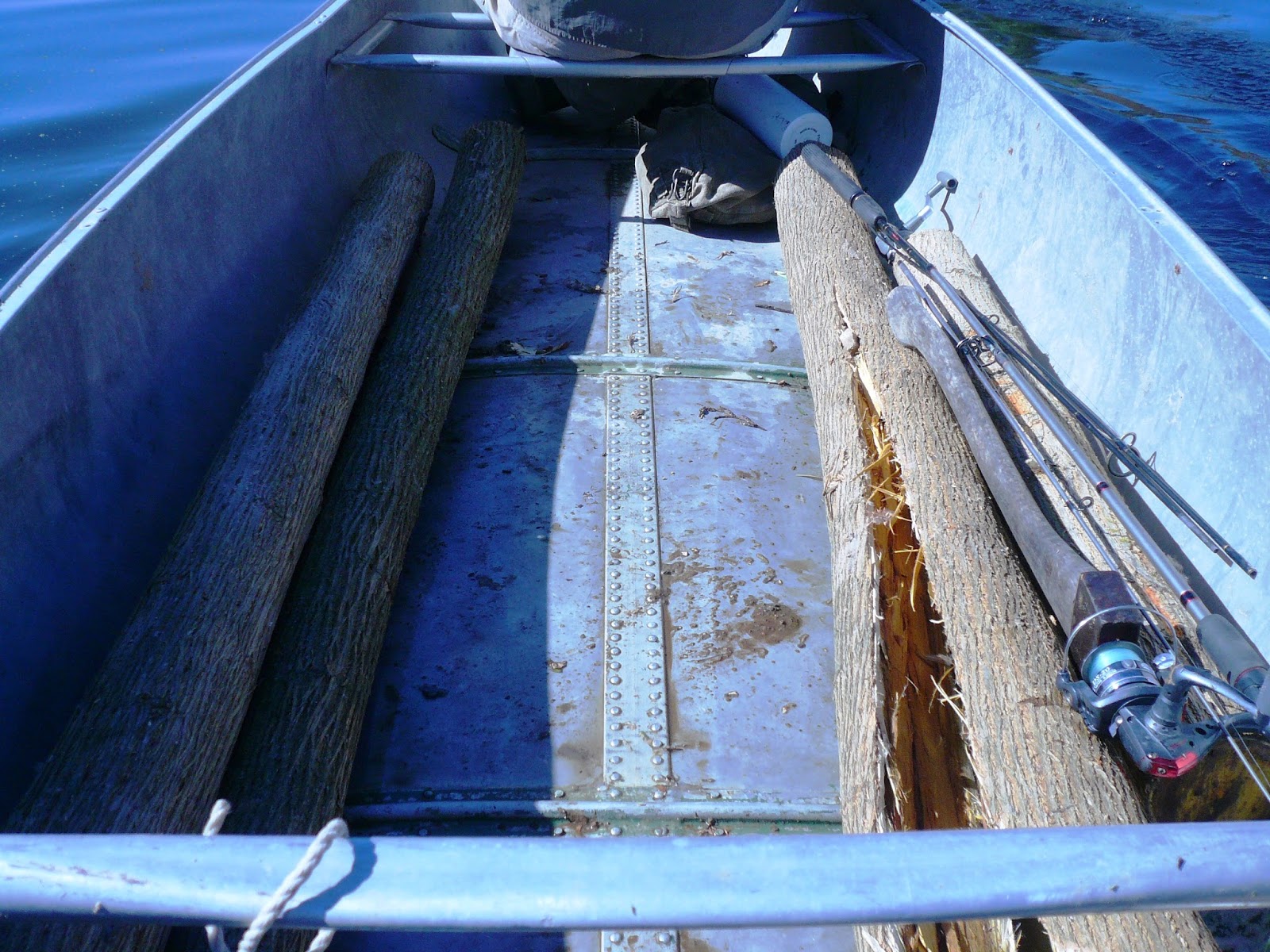

After inspecting and passing by countless trees we retuned with a canoe hull containing three trees specifically selected for properties essential to crafting sturdy hunting tools.


The split staves are then hewn down using an axe, drawknife and saw horse. My brother built the sawhorse above from scrap 2x4's. Finally the bare wood on the staves is coated with fat or wood glue to seal them in. This process promotes the wood drying from the inside outward (called seasoning) as opposed to drying from the outside in, which will cause the wood to crack (aka checking) like you see in firewood. Lastly, the staves are stored in an even temperature environment with low moisture content to season over a period of a few months to a few years depending on how thick the stave was and how dry the seasoning area is.


The following morning we entered the field just before sunrise in search of small game. While patiently waiting for our staves to season we opted to hunt with our trusty scatter guns. The tools are different, but the sentiment of subsistence hunting remains the same.


After spotting countless jacks and cottontails, my brother drew a bead on a nice rabbit.


Justin took a nice cottontail (his first with the new .410), and I got a decent sized jackrabbit.


The first night I made stewed jackrabbit with tomato-basil-balsamic sauce over polenta (with plenty for seconds). The following day I made a rabbit sandwich (pulled-pork style) for lunch, and last night I cooked up some rabbit tacos with homemade tortillas. It is amazing how much meat a single jackrabbit yields, and how tender and tasty they are if you know how to cook (despite the unwarranted bad rap they get).


There was still enough meat for me to make a Mexican torta for lunch today!


I also made an incredible pate from the rabbit livers. This is one of my new favorite snacks!


Justin will be cooking up our new standard, rabbit pot pie, with his cottontail tonight. 

If you have questions or comments please do not hesitate. Don't forget to subscribe.

And always strive to keep the old ways alive!


Sunday, August 30, 2015

Mountain Trout, Goose Berries, Elder Berries, and Pine Needle Tea


“To many a city man there comes a time when the great town wearies him. He hates its sights and smells and clangor. Every duty is a task and every caller is a bore. There come visions of green fields and far-rolling hills, of tall forests and cool, swift-flowing streams. He yearns for the thrill of the chase, for the keen-eyed silent stalking; or, rod in hand, he would seek that mysterious pool where the father of all trout lurks for his lure.”-Horace Kephart, 1917 : Camping and Woodcraft

Sometimes we need to get away from the pace of the city, far from jobs, shops, and luxuries. So it was that I found myself back in the woods, armed with my homemade maple longbow in search of blacktail deer.

Unfortunately I soon realized I was unable to concentrate on the hunt. Sometimes life overwhelms you to the point where you simply cannot escape a problem in your path. You cannot overlook it any longer. That was this past weekend for me.

As I contemplated deeply on the world around me, I hung up my bow and went fishing. After a few minutes casting a trusty Rooster Tail lure, I landed two nice trout.


A short search of the surrounding forest yielded numerous elderberries and perfectly ripe delicious gooseberries (in the family of currents but easily three times the size).


As the fish sizzled away on my old grill I picked young pine tips and brewed a small pot of pine needle tea…loaded with vitamin C and delicious as well!


The meal was fantastic! Just what the doctor ordered.


When I am in a calmer and more grounded headspace I will return to the high country in search of big game.

In the meantime remember to value those closest to you, to thyne own self be true, do unto others as they would do to you, and listen to Johnny Cash when you’re feeling blue!

Keep the old ways alive!

Thursday, August 20, 2015

Into the Woods: Six Weeks of Bushcraft


As a Ph.D student in archaeology, I had the honor of teaching archaeological field methods to a group of twenty undergraduates for the last six weeks in the mountains. I taught them excavation, survey, artifact analysis, mapping, and you guessed it...after hours, there was plenty of time for the old ways!


After work we took part in activities ranging from bow carving to harvesting wild blackberries and making a nice Dutch oven cobbler.


I was lucky enough to befriend a couple of archery deer hunters. Once successful they were happy to show the students how to butcher the buck they got. After I helped them with the process they offered us the skin, ribs, heart, a leg and even the loins. We were extremely grateful!


The meat was well appreciated! I now have a recipe/cooking method that makes venison ribs come out so tender you simply can't stop eating them!


Some of the students were really interested in seeing if we could replicate the stone scrapers and flake tools we had been finding and try to use them in traditional hide tanning. I showed them my methods for making a frame, lacing the hide, softening, and smoking it, and they set to work with perseverance and great success!

One of my favorite times was when we got out some old cans, wound them up with fishing line and brought some lures along for a little hobo fishing.
We found massive schools of very aggressive giant pike minnow and fished with great success!


I'm not sure what happened to the photos of the fish cakes we made, but I can tell you they were a big hit!
However, nothing beat the tasty fry bread our wonderful Native American Monitor Deb made us.


Those are definitely smiles of total contentment!
With the skills Ryan had cultivated with his knife over the last six weeks he carved and erected a sign in honor of the ditch we'd come to refer to as Shane's Folly (where Shane's car and several others bottomed out and rolled away with flat tires).
It was six weeks with lots of laughs and plenty of adventure for those who love bear country. I will never forget this time and I look forward to all of the interesting research these students generate from the artifacts we identified, mapped, collected, and are currently analyzing.
Keep the old ways alive!