Saturday, August 30, 2014

Hillbilly Fusion Revisited: Thai Red Curry with Frog Legs


DISCLAIMER- If you are really backwoods, a real hillbilly, or swamp person, please know I mean you no disrespect with this post…it is all in good fun!

The first time I had dinner with my brother’s girlfriend Karen, she asked us all to check out an awesome Chinese restaurant in San Francisco. On the menu, among other delicious sounding dishes, I saw spicy Cantonese frog legs. As I was trying to make a good impression I summoned my strength and did not order this delicious sounding feast! However, since that day I have been craving frog legs cooked in a not-so-western style.

If you think squirrel sounds like hillbilly food, I have to say, to me, frog legs sound like downright swamp-people fare. Yet they are delectable!
Photo- Jarek Tuszynski
The American Bullfrog (Lithobates catesbeianus) thrives in the wetlands, bogs, rivers, ditches, and every other moist habitat it can find here in California. Yet it is not a native species! In fact, the American bullfrog is responsible for the decimation of many invertebrates, competing native species, and yes even our beloved native salmonids i.e. salmon and steelhead fry. They are such cunning and relentless hunters that in many California lakes and bodies of water with current high concentrations of bullfrogs, all salmonid restoration efforts have ceased until these green eating machines are completely eradicated. This is a sad state of affairs for our native species, especially the red legged frog (Rana draytonii) which have been decimated by this intruder. Yet once again, we hungry foragers (and all of you I hope) are coming to the rescue. It is true that bullfrogs are not native, but few people realize that they were originally introduced for food…because they taste soooo good!


My partner-in-crime, and best buddy, Alex was completely on board when I proposed an all night hillbilly-style frog giggin’ adventure. He arrived shortly thereafter and, with a few straps and a whole lot of elbow grease, we had the two-man kayak delicately balanced on the small roof of his Honda Civic. The night before we had scouted the pools that we intended to hunt and had heard the unmistakable croak of bullfrogs en masse…if you can call them croaks…they were more like growls! These little amphibians have an ominous and thunderous call that resonates so deep into the darkness that if you did not know they were frogs, you might think twice before a stroll along the lake shore. However, we knew exactly what we were hearing thanks to many a hillbilly happily sharing frog gigging tips on www.youtube.com.


We began by rigging up our aqueous hunting equipment. The tool of choice for lacustrine environments is an effective and menacing implement known by a simple name—GIG! We constructed two cold steel tipped frog spears complete with hand carved barbs. Alex fashioned his from an old three prong pole spear tip that had brought me many calico bass in southern California, and him many rockfish in northern California. He hafted this to a carbon fiber shaft and attached a bungee to give the spear more thrusting power. I went old school and used nothing more than a somewhat straight ash wood shoot I had cut a while back, some string and electrical tape for hafting and two welding rods I cut in half for prongs. These four prongs were fit snuggly into the business end of the gig after I pounded the tips flat with a hammer and anvil and sharpened points and barbs with a file.

When the sun went down we headed to the water heaving along my uncle’s old two man kayak. On the way we met a couple Latinos fishing and chatted one on one about forager cuisine. They recommended using quartered fish (bluegill to be specific) in a spicy fish soup...sounds pretty good to me!

Before we hit the water we had to have some last minute laughs while there was still light so we put on mullet wigs, beards, and whatnot and filmed a hillbilly how-to-gig video clip. By the time the sun went down and we waded out through the aquatic vegetation and mud to launch our watercraft, we were all smiles.


The next half hour we paddled up and down the banks listening to the sounds of the wetlands at night. Cranes, owls, Canada geese, and our favorite, the frogs! I know it is going to sound immature, but I have to say that when a frog doesn’t quite get the croak to come out right, it sounds like a huge fart! So needless to say, many a silent stalk, ready for an accurate shot was destroyed by one of us bursting into laughter after a frog piped up in just such a manner.
By the end of the night we had two frogs each! We were hoping for just one each as it was our first time. We were completely content!


The next morning (late, as we were awake until 2am hunting), we cleaned our quarry and began cooking. The kaffir lime leaves from my mom’s tree inspired the dish, and after a lot of fun adding this and that in the kitchen, we triumphant foragers enjoyed a batch of Thai frog leg red curry that was so good all that could be heard when we ate it was mmmmmmmm! The texture of these frog legs was somewhere between chicken and fish, and the flavor was subtle yet intoxicating.


So remember, be a conservationist, help out the wetlands, and bring some food to the table too! If you live near a lake, pond or wetland where it is permitted, give giggin’ a try!
Keep the old ways alive!

Sunday, July 13, 2014

Lean-to on the North Coast

"You got any cheese?"- Ben Gunn (a marooned character) from Treasure Island

Sometimes you just have to get away from it all. Away from the hustle, noise, concrete, and streets, from the buildings, the cars...you just have to go far!
This day, in the old way, I hiked to a secluded cove, 
there on the scenic north coast with no tent and not even a stove.
Driftwood, and my grandfathers old pancho became my lean-to, with warmth of fire, I enjoyed one of the best beaches I've been to.

I speared some black rock fish with my brother the day before; he nailed a nice lingcod. I intentionally speared one in the eye to keep its form pristine as we hope to make a traditional Japanese fish print (gyotaku) soon. The second rockfish was to be my dinner, paired with foraged peach, plum, blackberry, and apple...my wild fruit salad.
The hike in was really pretty with vast open views of the northern Pacific Ocean.
 There was no stone-free spot above the high tide mark for my bed, and no conifers to lend me boughs for a padding, so I set to work systematically removing as many stones from a small patch as I could while the sun set. 


 I found ample driftwood for constructing the frame of my lean-to and for fire wood. Paired with my grandpa's old WWII pancho I had a nice bushcraft shelter in no time flat.


 Again, my new Black Pine down sleeping bag kept me toasty warm even in the thick coastal fog.


 I was unable to get a decent shot of my dinner plate...but trust me, this was a great meal...and 100% free!
 I woke up to a very vocal group of baby river otters wrestling and foraging in the surf. In historic times when the Russians first settled the north coast, establishing a major settlement at Fort Ross, they hunted sea otters to the brink of extinction. River otters have now moved into the inner tidal zone enjoying the bountiful fish and shellfish resources that can be found here.


 After washing up in the sea, I got a batch of cowboy coffee going on the coals. I didn't have any bacon (a bushcraft fopaux) but some sauteed salami paired quite well with the left over fruit salad, and potatoes with homemade sea salt and herbs from the garden.
 With an old chair leg I found in the driftwood pile, and a notched stone sinker, I set up a hobo fishing rig. Yet, try as I might, I had no luck. 


 So, as the tide went out, I switched my focus and gathered limpets and tegula. Many people do not know that bivalves such as mussels and clams are toxic in the summer months, yet mollusks and gastropods are edible year round.
 I paired beer battered calamari-style limpets with homemade onion rings as a nice little snack.
 While picking berries the day before, I had also came across some yerba buena...which makes excellent tea!

A week before I had purchased a butter knife from a thrift store for 23 cents. With a little modification I transformed the silverware into a fully functional crooked knife.


 A crooked knife is a wonderful Native American innovation that makes bowl and spoon carving much easier.
I also hollowed some carrizo cane I found in a creek to make a pipe through which I could concentrate my breath to get the coals forge-hot in a blue oak bowl blank. By alternating fire charring and scraping with my dirt-cheap crooked knife, I started making real progress with my new bowl.

 Of course, splitting a willow into tongs for grabbing hot coals is also essential to the process.

 I took a little walk to check out some of the local flora.


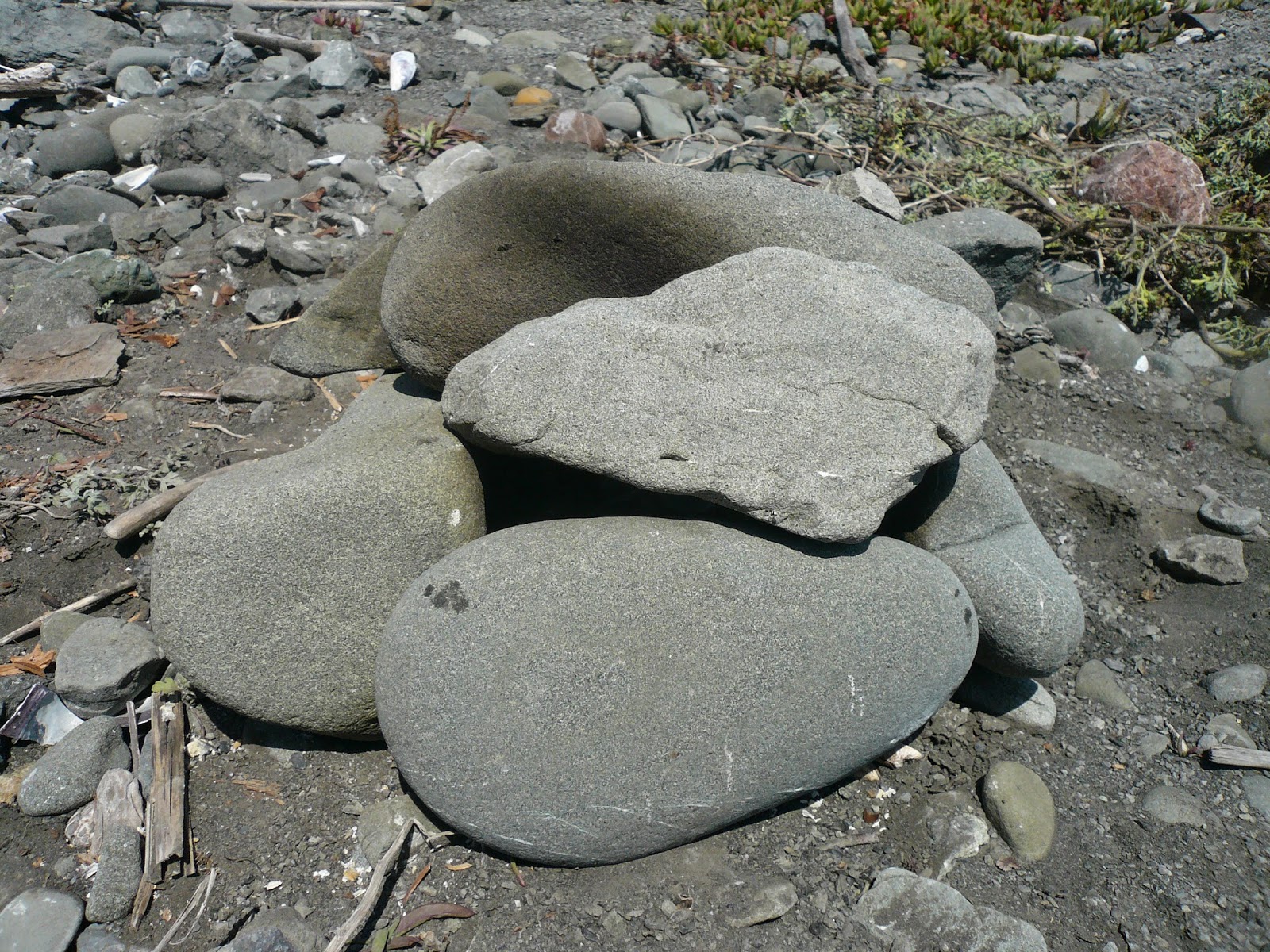
And ended up finding some nice Franciscan chert for flintknapping. Of course, this stone requires a special process known as heat treatment to make it workable, but a quick search to the recesses of my brain found a successful procedure. I used the ash that had accumulated from dinner and breakfast to help insulate the chert blanks, and built a new fire over the top which allowed the stone to slowly increase in temperature, hold at a specific threshold for a predetermined period of time, and slowly cool back down.

  The process was totally successful! I will show you the results when I get around to flintknapping again.

A few hours later it was time for a late lunch. I find that bringing a dry salami and dry aged cheese such as Asiago or Parmesan is a good way to go when refrigeration is limited. In fact I got the idea to bring Parmesan from Treasure Island by Robert Louis Stevenson. In the story, the character Ben Gunn who has been marooned on the island for years keeps asking each new person if they have any cheese...the one item he misses most. Towards the end of the book, one of the men brings him a small block of dry aged Parmesan. 

With the homemade sea salt, herbs, and flour, I made a flat-bread style bannock which I seared on a little wooden grill.

 I then built a sandstone oven and got a piping hot fire going within its walls.
 I placed the bannock in my new oven topped with an olive oil sauce, Asiago, salami, caramelized onions, and the last of the oyster mushrooms from last season (re-hydrated with fresh ocean water).
The resulting pizza was absolutely fantastic!

When I was finished eating I packed up my gear and said farewell to my little cove. Sure to scatter stones back where I had slept so that only a sleuth would know that anyone had been there. Remember, always tread lightly! It is how we preserve the beauty and majesty of our pristine wild places.
Keep the old ways alive!