Saturday, September 19, 2015

Cooking Mussels in a Cave: A Story from a Few Winter's Back


I forgot to post this story when it happened and I just came across the images so here you are!
Remember, mussels are not safe to eat in the summer months...the following is a story from the winter time when mussels are safe to consume and therefor a delicacy we enjoy every rainy season!

Sometimes you just have to get out there, rain or shine, get out into the sea and harvest bivalves-a-plenty!

We look forward to the clam and mussel harvest every year. So when it was time and the tides were out, my dad and I headed into the intertidal zone with buckets, fishing licenses and big appetites!

After a bountiful and very easy harvest we headed for a favorite cave to cook our fresh seafood feast over hardwood coals.


Beams of sun filtered in through cracks in the walls and illuminated a heck of a good meal!

We ate our fill and enjoyed every bite of this fresh sea fare.

Well, my good buddy just got back from adventures in the high Arctic, so I'm off to go fishing or bow carving again!

Don't forget to subscribe and/or leave a comment.

Keep the old ways alive!


Sunday, September 13, 2015

Hand-Forged Knives, Powder Horns, and Rabbit Pot Pie: My Brother Has Been Busy!

"Why do jackrabbits get such a bad rap? They are so good! It's like those guys who say you can't eat a wild boar over 200lbs because it tastes terrible. It's simply not true! I guess we let them keep thinking that though...more for us!"- My brother

I have always looked up to my older brother Justin. He's the type of guy that would give you the shirt off of his back if you needed it! Unlike most big brothers he was always kind and patient with his younger brother, and I have always deeply valued his friendship.

He also happens to be a badass and, as a Smith, he is of course quite talented with any craft he takes up.

He came to visit me in the woods over summer and after a couple of outings he took a jackrabbit with his old trysty Sheridan .20cal pellet rifle. He's been hunting with the same pellet gun since he was 11 years old!


The rabbit went to another pot pie which Justin said was incredibly tasty!


Beyond bunnies, Justin has been working away with a hammer, anvil, and forge. He has produced some excellent blades over the past few months and even gave me one!


Mine is the Kephart with the incised bone handle on the left
 
He even made the leather sheath in the image above!
 
After a while, Justin mixed things up a bit and began crafting powder horns for our black powder muzzle-loading rifles! I can't wait to takeout our old .50cal's with these beauties on our hips!


Justin and his buddy Eric also got out for some very productive freedive-spearfishing recently...4 lingcod and a nice cabazone is not a bad catch at all! Fish and chips anyone?
 
 
Well, I can't stand being indoors on a nice cloudy Sunday so I am off to walk the wild side...wish me luck!
 
Leave a comment, don't forget to subscribe, and always strive to keep the old ways alive!


Sunday, September 6, 2015

Fresh Fish Civiche: A Tutorial

"Work is for people who don't know how to fish." - A Favorite Bumper Sticker

Step One- Catch Fish.
Step Two- Review my former post on boneless fillets and fillet your fish
Step Three- Cut fish into half inch or quarter inch cubes


Step Four- Blanch fish for two minutes in boiling water (traditionally this is not done, only the acid of the lime juice cooks the fish...call me paranoid but I always blanch my fish to be double sure).


Step Five - Drain and allow fish to cool. Then cover with fresh lime juice.


Step Six - Prepare ingredients. These include chopped tomato, onion, cilantro, and avocado. Spices include cumin powder, chili powder, salt and your favorite hot sauce (to taste).


Step Seven - Mix masa, a little salt, and water, press some fresh tortillas and fry until crispy and golden brown.


Step Eight - Drain excess lime juice from the fish, add all ingredients (except avocado) and mix thoroughly. After it is well mixed, add the avocado and lightly mix (otherwise the avocado will mash up and the ceviche will not look appetizing at all). Give it another squeeze of half a lime, add salt to taste.

Step Nine - Place equal portions of ceviche on each homemade tostada and garnish with a sprig of cilantro and dash of hot sauce.


I ate these for dinner along with a homemade foraged blackberry soda...but more on those tasty beverages later.

I promise you, this is one of the best lunches on a hot day by the beach that anyone could ask for. The ceviche is cold, tostadas are hot, and the combination is incredible!

Give it a try and leave a comment.

Don't forget to subscribe.

Keep the old ways alive!

Saturday, September 5, 2015

Out for Osage Orange: and Semi-related Rabbit Ramblings

"The best vacation an over-civilized man can have is to go where he can hunt, capture, and cook his own meat, erect his own shelter, do his own chores, and so, in some measure, pick up again those lost arts of wildcraft that were our heritage through ages past, but of which not one modern man in a hundred knows anything at all. In cities our tasks are so highly specialized, and so many things are done for us by specialists, that we tend to become a one-handed and one-idead race. The self-dependent life of the wilderness nomad brings bodily habits and mental processes back to normal, by exercise of muscles and lobes that otherwise might atrophy from want of use." - Horace Kephart 1917


My brother and I have been carving bows from timber we have hand-felled for nearly 15 years. We got out by canoe the other day in search of the greatest bow wood on Earth- Osage Orange.
Osage (Maclura pomifera), aka bois d'arc, or hedge apple, was originally introduced to the Far West of North America as a resilient thorny hedgerow and was originally marketed to keep livestock in the confines of a family's land. Osage spread rapidly and was commonly used for this purpose until the innovation of metal barbed wire fencing. Today, it is a difficult tree to locate in some areas...but with a little research learning to identify this king of bow woods, we found a substantial and healthy stand in an otherwise fallow riparian forest.
Armed with my trusty Japanese cross-cut saw (thanks to Ron), a couple of axes and hard-wood wedges my brother had carved the night before, we set out in search of straight-grained staves from which we hope to carve top-of-the-line longbows.

A great deal of time is necessarily spent tromping through thick wooded areas in search of the proper branch or trunk from which we can free a bow. Bowyers (bow makers) must carefully inspect each prospective tree to be sure it is relatively knot-free and that the orientation of the bark indicates straight wood grain within.


Once the proper stave is located, the "work" begins as traditional bowyers like us take great pride in fashioning our hunting implements without the use of power tools. Cut a four inch diameter willow trunk with a hand saw and you'll break a sweat, but try cutting four inch thick Osage and you will know why it makes such a strong bow! This wood is hard as steel and tough as nails!

Osage also has minimal sap wood when compared to many trees. You can see there is only a thin band of light sapwood in the image above, the rest consists of early and late growth heartwood.


Occasionally you have to go out on a limb (literally) to find and cut the right stave.


Next, wooden wedges are driven into the felled trunk or branch to split straight and even staves for later seasoning.


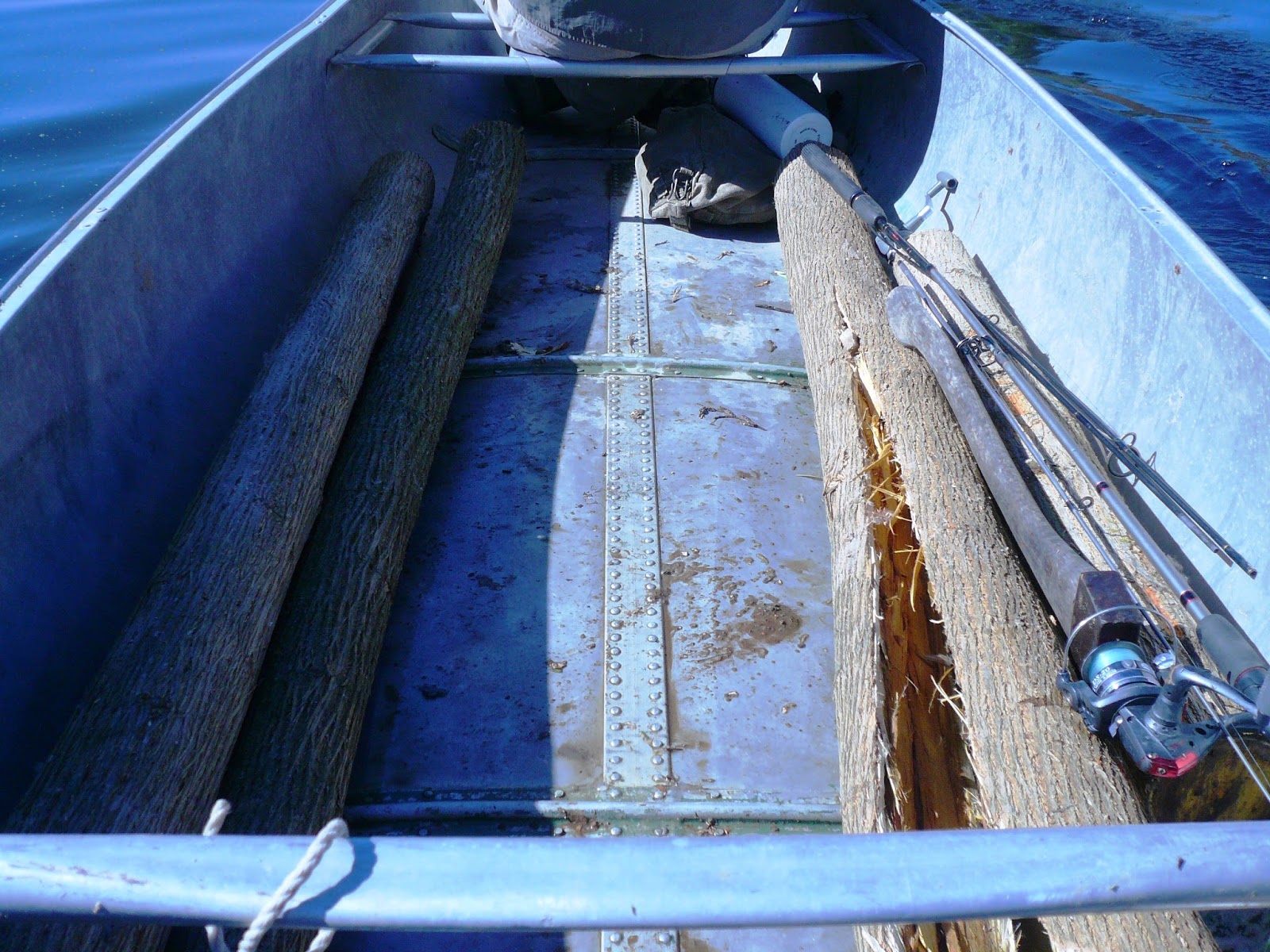
After inspecting and passing by countless trees we retuned with a canoe hull containing three trees specifically selected for properties essential to crafting sturdy hunting tools.


The split staves are then hewn down using an axe, drawknife and saw horse. My brother built the sawhorse above from scrap 2x4's. Finally the bare wood on the staves is coated with fat or wood glue to seal them in. This process promotes the wood drying from the inside outward (called seasoning) as opposed to drying from the outside in, which will cause the wood to crack (aka checking) like you see in firewood. Lastly, the staves are stored in an even temperature environment with low moisture content to season over a period of a few months to a few years depending on how thick the stave was and how dry the seasoning area is.


The following morning we entered the field just before sunrise in search of small game. While patiently waiting for our staves to season we opted to hunt with our trusty scatter guns. The tools are different, but the sentiment of subsistence hunting remains the same.


After spotting countless jacks and cottontails, my brother drew a bead on a nice rabbit.


Justin took a nice cottontail (his first with the new .410), and I got a decent sized jackrabbit.


The first night I made stewed jackrabbit with tomato-basil-balsamic sauce over polenta (with plenty for seconds). The following day I made a rabbit sandwich (pulled-pork style) for lunch, and last night I cooked up some rabbit tacos with homemade tortillas. It is amazing how much meat a single jackrabbit yields, and how tender and tasty they are if you know how to cook (despite the unwarranted bad rap they get).


There was still enough meat for me to make a Mexican torta for lunch today!


I also made an incredible pate from the rabbit livers. This is one of my new favorite snacks!


Justin will be cooking up our new standard, rabbit pot pie, with his cottontail tonight. 

If you have questions or comments please do not hesitate. Don't forget to subscribe.

And always strive to keep the old ways alive!